01
ECOA / Regulation B
Adverse action & protected-class testing
TEST


An Aquarient AI & Intelligent Solutions Accelerator for banks, mortgage lenders, credit unions, and consumer finance institutions.
[ECOA] [HMDA] [CRA] [SR 11-7] [Fair Housing Act]


A scheduled federal exam was always a forcing function, not the actual source of the underlying legal exposure. Institutions that keep testing continuously, at the population level, with a documented and explainable process are positioned to demonstrate good faith if that exposure ever surfaces through a private suit, a state inquiry, or a reinstated exam cycle.


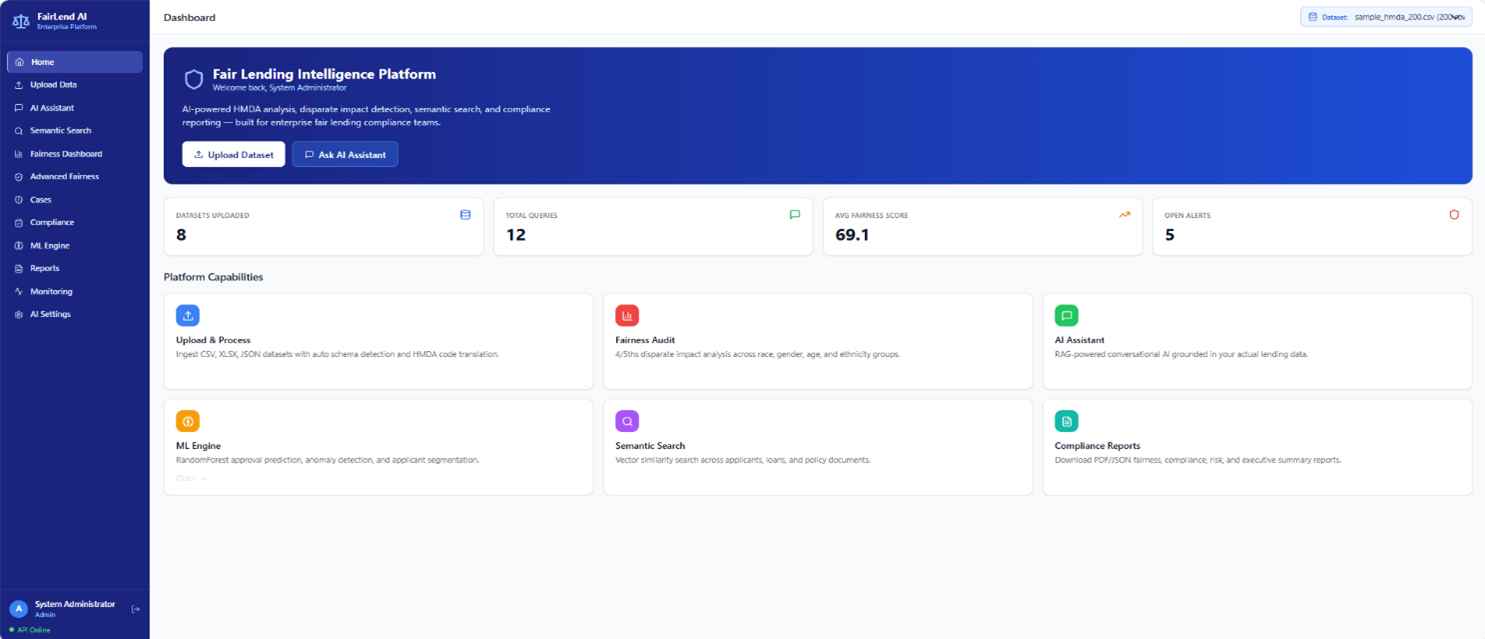
Upload HMDA LAR, German Credit, or Fannie Mae data. FairLend AI maps, cleans, scores, and indexes the dataset.
Run Four-Fifths Rule, Equalized Odds, and intersectional testing across every uploaded record.
Flagged results automatically create tracked cases with SHAP-based explanations and adverse-action support.
Run HMDA and CRA checks and package findings into compliance-ready reports.
Compare new uploads against historical baselines to identify drift and emerging bias spikes.

Adverse action & protected-class testing
LAR validation & submission readiness
LMI mapping & coverage analysis
Model validation & explainability
Disparate impact & treatment analysis
Tests 100% of applications on file, not a manually pulled sample of a few hundred loan files.
Every finding — a ratio, denial, or anomaly — comes with a SHAP explanation traceable to applicant-level features.
Automatically creates a case when a result crosses a severity threshold, with a full audit trail and assigned owner.
Packages datasets, test results, and case histories into an exam-ready evidence package for regulators, auditors, or your board.
Monitors every new upload for data drift and bias spikes, rather than waiting until the next examination cycle.

HMDA Loan/Application Register (LAR) exports, German Credit format, and Fannie Mae schemas, in CSV, XLSX, or JSON, with automatic mapping to the platform’s canonical fields.
Arguably more so. Federal supervisory exam activity has been reduced, but ECOA and the Fair Housing Act still give individual applicants a private right to sue, Fair Housing Act disparate-impact theory remains valid law, and state regulators are increasingly active. Continuous, population-level, explainable testing is what lets an institution show good faith if that exposure surfaces through any of those channels not only through a scheduled exam.
Established platforms are built around statistical dashboards and regulatory reporting. FairLend AI adds a modern ML layer on top of that same statistical foundation SHAP-based explainability tied directly into individual ECOA adverse action letters, a natural-language assistant grounded in your own data, and automatic case creation in one closed-loop workflow rather than separate tools stitched together.
No. It automates the testing, explainability, and evidence-packaging work that doesn’t require a judgment call, and routes everything that does a flagged disparity, a low-confidence result to your compliance officers as an owned, tracked case.
It’s an Aquarient accelerator a proven fair lending testing and case management foundation configured to your data formats, your institution’s risk thresholds, and your existing compliance workflow.
